The new Afghan Women’s Writing Project matches female Afghan students with overseas teachers and readers. Volunteer writers lead online classrooms and the resultant pieces are posted on the project blog http://awwproject.wordpress.com/about/ . Reader responses are not only welcomed, but highly appreciated by the young women writers. Please check out their poems and stories and let them know that they are heard.
Every morning when I start my day, I pray for the soul of my father. I put red roses on his grave and I kiss his grave soil and I think: where I kiss is heaven.
I agree with Sarah Palin that the best road trips are taken by plane. So, this year I booked a flight to Halifax, Nova Scotia, to visit my brother Leon (see "Men's Planet II: The Apartment" on Matahariette.com) who has been afflicted with an acute case of Empty Nest Syndrome ever since my nephew went away to college a decade ago.
This past year was stressful. Not only did I endure my Long, Epic Battle with the Faceless Monster Verizon (see July 16th "Corpse"), which began in December, '08 and was resolved to my dissatisfaction in May of '09, but my neighbors, Dave and Dean, a gay couple, had solicited my help in a fierce custody battle over a sweet-tempered puppy, Bernardo. Bernardo was not the name given to him by his original owner (hereafter referred to as "Prima Donald.") Dave and Dean (hereafter referred to as "Da Boyz"), have a joint crush on George Chakiris, the Greco-American actor who played Bernardo, Leader of the Sharks in "West Side Story." Da Boyz worried that a name change might be traumatic to their canine charge.
“Governor Nelson Rockefeller declares Woodstock a national disaster area.” Woodstock was on the front page of the New York Times for days. My mother, who had allowed her barely 16 year old daughter to go to this rock concert, was appalled. But to her it wasn’t the lack of amenities that was horrifying, it was the sight of her daughter dressed in a blue work shirt and blue bell bottom jeans, surrounded by half-a-million other young people attired in the same fashion that ran a chill down her spine; it reminded her of something more sinister and repugnant, though in her day they wore brown. In our matching uniforms of blue, armed with tents and sleeping bags, and with the help of an endless downpour we were about to turn the green upstate fields on Yasgur’s farm into a mire.
In the pelting rain the pasture turned pigsty -- a vast expanse of boot sucking mud and oozing offal. With only 40,000 tickets sold and 500,000 people present the concession stand ran out of cokes about the time the Porto-Sans overflowed.
Excerpt from "The Egyptian Chronicles: How a Mom-and-Son Duo Skirted Terrorists, Dodged Suitors and Heard the Gods Speak"
The Supreme Guide of the Council of Antiquities of Egypt is a small, compact sparkplug of a man fond of his laser pointer. With typical modesty, he announces, "I have a great respect for Howard Carter--Carter never moved Tut's remains. He left that to me."
Tutankhamen's tomb is projected on screen and submitted to precise laser probing while I take my seat as discreetly as possible in the conference hall of the new Biblioteka Alexandrina, the latest incarnation of the renowned Library of Alexandria, one that meets current seismic and fire-safety standards. No crazy Caesar is going to set this place aflame--there are no books to burn. In an institution prepared to house over three-million volumes, a flimsy 250,000 fill the shelves. All the money for the library was spent on the architecture.
In 2009 the world watches crowds in the streets of Teheran. Reporters searching for perspective remind us that it’s been thirty years—since the revolution of 1978-1979--since so many people have taken to the streets of Teheran. At the same time some American politicians have apparently developed amnesia about Persian-American history. There are calls, by some, for America to talk loudly about supporting democracy in Iran, forgetting that our history in Iran means Iranians would see such talk as hypocritical.
No one in America, not even President Obama, speaks frankly about the details of America’s history in Iran or why that history has left such an abiding rage towards America in Iran.
I was fortunate enough to be on the streets of Teheran in the fall of 1978, one of the few Americans who witnessed firsthand the popular rage that lead to the birth of the Islamic Republic of Iran. I walked the length of what was then called Pahlavi Street, crossing Teheran from North to South, on November 4, 1978. One year later American embassy officials were seized as hostages, on November 4, 1979. They were taken hostage in 1979 to commemorate the events that happened one year earlier. While the world remembers the taking of the hostages at the end of the Iranian revolution I recall a day of rage, a year earlier.
Our contributor Andrei Molotiu writes: „Looking on an old hard drive, I found about three pages of my own Romanian version of Georges Perec's "Je me souviens"--which I wrote one night, though fully realizing that the project was completely pointless, quixotic. As I may have told you, I left Romania at fifteen (almost sixteen), in 1983. So, really, all the memories of Romania I can invoke are from the late seventies, early eighties. On one hand, because I left and no new memories (in Romanian) came to replace them, they're totally frozen in time. On the other, they mean absolutely nothing to any American, and probably very little to any Romanian too--since, if they never left, the various things I recall will probably have a very different resonance than they have for me. Perec--despite his life of loss, especially the loss of his parents--never lost his culture, lived in Paris his whole life, and so could count on people with the same experience as his responding to his obscure cultural memories. I--well, I don't really have that at all. I realize that, since you came here in the '60s, some of these references may mean nothing to you either--but I think you may get a few glimpses of recognition, which is significantly more than 99.9999999% of possible readers might get out of it. (And please excuse the lack of diacritics!)”
Editor’s Note:We found Andrei Molotiu’s reminiscences quite poignant, in and of themselves, but also because he references the form as having been invented by Georges Perec, while we believed all this time that it belonged to Joe Brainard and his immortal „I Remember” (Kulchur). The very interesting transmission of Perec (French) to Brainard (American) to Molotiu (Romanian) makes this a tri-lingual delight. We are publishing it in Romanian (sans diacritics, as A.M. notes,) and hope to encourage writers in other languages to do their own „Je me souviens/I Remember/Imi Aduc Aminte,” for publication in the Corpse.
LATE BREAKING NEWS: this just in: " A couple of precisions/corrections: I was writing very late at night: I wrote "Perec" because that was my first acquaintance with the "I remember"--I'll switch and call it "je me souviens"--genre, but of course Joe Brainard came first. As I understand it, Perec learned about it from his friend Harry Mathews, but began writing his version without having actually seen Brainard's book. So, he got it a little bit wrong, or different. While Brainard more or less used the "I remember" conceit to write a fragmentary autobiography, Perec was not so much concerned with his own biography but with the cultural memory of his period--so he wrote much less about his own experiences, and more about little tidbits of forgotten culture, tidbits that could evoke a frisson of recognition from his contemporaries. Little Proustian madeleines, in a way. I think mine are more in the Perec mode, though perhaps not entirely. One more thing: having left Romania at fifteen, not only are my memories frozen in place, but my mastery of Romanian may be too, so I don't know how correct much of my grammar or word choice is. I was going to ask you to proofread it but, again, maybe it's better this way: the stilted phrases going along with the half-remembered facts. Which leads me to another point: I'm sure there are mistakes in what I remember. But I'll follow Perec's example and leave the mistakes be, not check them. This is about my memory, faults and all, not about historical truth. Or at least it's about the historical truth of my own memory. Editor's Note 2: In view of the late breaking news above, we call on a) literary history to reformat itself correctly, and b) can a Romanian poet enter the diacritics and correct (corijeze) what might be linguistically unspeakable in 2009, and send us the diacriticalised & corijized text in Word attachment? Multzam.
It was in the winter of 1982 when I moved to the Bucharest Municipal Hospital at the recommendation of a friend of the family who happened to be the director of the facility.
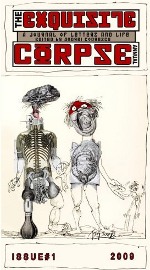
PRESS RELEASE: LEGENDARY LIT JOURNAL BACK IN PRINT!!! ADVANCE COPIES OF EXQUISITE CORPSE ANNUAL #1 ON SALE NOW! Ed in Chief Andrei Codrescu presents artwork by Ralph Steadman, Joel Lipman; poetry by Diane di Prima, Bill Berkson, Alice Notley, Mike Topp, Jim Gustafson, Ruxandra Cesereanu; prose by Jerome Rothenberg, Willie Smith, Aram Saroyan, Lance Olsen, Davis Schneiderman; and more more more! So get your historic freak on!
Send a check made out to "UCA" ($20 per issue) to Exquisite Corpse Annual/Department of Writing/University of Central Arkansas/Conway, AR 72035 or send PayPal payment to This email address is being protected from spambots. You need JavaScript enabled to view it.. For intl. orders please add $7.50 per issue for shipping. Lifetime subscriptions $100. Also available on Amazon.com .
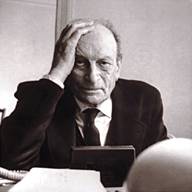
Veteran film-maker Bertrand Tavernier (Coup de Torchon) did a documentary on the surrealist poet Philippe Soupault in the early 1980s when Soupault was about 85 years old. In this clip from that documentary, Soupault is talking about a text he wrote when he was still in his mid-twenties titled Invitation to a Suicide. He had thirty copies of the book printed, and sent one to the woman to whom it was addressed. The woman said, why don't you just come and live with me instead. He did, and destroyed the rest of the edition. Still alive some sixty years later, he talks about this text, and other suicides of the surrealist movement such as Jacques Rigaut and Rene Crevel. Throughout the interview, Soupault chain-smokes, as he apparently did right up to his death at the age of 93 in the year 1990. Shortly after this interview Soupault had to have his vocal cords removed, and then spoke in a high strained voice thereafter. The man that Soupault is speaking with is Jean Aurenche, who had a screenwriting career spanning some sixty years. Other clips from this hard-to-find documentary can be found through Googling Soupault using the video function. One sees the inside of his extensive apartment near the Bois de Boulogne (where he lived with his wife the fantastically talented photographer Re Soupault), and hears him talk about his hobbies, like taking aluminum chocolate wrappers and making them into giant softballs. At 85, he's still joking and smoking. He would live another eight years and write several volumes of autobiography entitled Memoires de l'Oubli, as well as very good poems write up until the end. He provides a different model of how to get very old, in that he has kept his humor and his intellect, and never resigned himself, but remained interested in visitors, and liked to visit with the children of his building, for whom he saved stamps from his vast correspondence.
Two able crackies stood outside my motel room attempting to convince me that there was only one able cracky knocking on my door. But I could hear two crackies whispering to one another. A few days prior cracky number one, whose name was Abel, had noticed my out-of-state plates and directed me to a cracked hotel where all crack related services were provided at little financial cost and great spiritual loss. I thanked him for his considerate recommendations and found my own meager motel with a relatively clean room and a low-lit bar tended by a gorgeous woman.
I went to research this small town in north-western Illinois with hopes of discovering a female character.
“A river of arctic air coming down from Canada” is how many weather reports have described the recent cold snap refreshing a huge swath of the country, from Minneapolis to Miami. My nose told me that Murfreesboro was right in the middle of it.
On Tuesday morning in International Falls, Minnesota, the mercury set a record for that date when it went down to 40 below, on the Fahrenheit scale. The “river” characterization accurately implied that there was also a good amount of wind-chill to dress for.
Coincidentally, 40 below is the same frigid temperature on both the Fahrenheit scale and the Celsius scale, which they use across the border from International Falls, in Fort Francis, Ontario. Folks in Minnesota and Northern Ontario will agree that 40 below is definitely cold, but scientists will tell you that it is not absolutely cold.
Temperatures on the Fahrenheit and Celsius scales are defined relative to fixed points. For instance, on the Celsius scale, proposed in 1742 by a Swede named Anders Celsius, the freezing and boiling points of pure water, under normal atmospheric pressure, define O. and 100. degrees, respectively. All other temperatures are relative to these.
Water figures prominently in the definition of the Fahrenheit scale as well, but not pure water. If you’ve ever made ice cream the old-fashioned way--churning a mixture of rock salt and crushed ice that surrounds a can of fresh cream, sugar and other goodies - you know that the saltwater slurry gets darn cold. The ice cream mixture will slowly harden, or “freeze”, but the salt and ice appear to melt into one another. Using the same thermodynamic principle, highways can be kept ice-free in the winter, but only to a point.
The point was discovered in 1724 by Daniel Fahrenheit, a German physicist, who wondered what concentration of saltwater would yield the lowest possible freezing point. It takes a lot of salt to reach the optimum mixture, but once you’re there, you’re as low as you can go. Any more, or any less salt, and the mixture will freeze at a temperature that is above zero on the Fahrenheit scale.
As folks in International Falls know, you can go lower. A century after Fahrenheit and Celsius weighed-in with their scales, a Scot named William Thomson became very interested in temperature’s role in the practical applications of thermodynamics. In 1864, from carefully measured properties of relatively warm gases, he predicted that temperature on the Celsius scale could never go below 273.7 degrees below zero, ever. He called this temperature “absolute zero”, and the temperature scale that begins and ends there is named after his subsequently acquired title of Baron Kelvin of Largs.
Under normal atmospheric pressure, air starts to liquefy at 190 degrees below zero on the Celsius scale. So there were some major experimental challenges to surpass before scientists would know whether Lord Kelvin was right. Air is mostly made up of the gases nitrogen and oxygen, in about a 4 to 1 ratio. Liquid nitrogen boils at 77 degrees on the Kelvin scale (which is a really cool 320 degrees below zero on the Fahrenheit scale), and is often used by dermatologists to remove pre-cancerous skin lesions.
A few years ago, during National Chemistry Week, which is held each fall, students in the MTSU Chemistry Club delighted local elementary school students with another use of liquid nitrogen--making ice cream ! (I guess the tediousness of churning salt and ice for thirty minutes or more just doesn’t appeal to youngsters today.) Using the same ingredients of cream, sugar and goodies, but just mixing in a couple liters of liquid nitrogen, the frozen treat was ready to eat in a few minutes. No salt, no ice, no bucket or crank (unless you count the seasoned chemistry professor who misses the thermodynamic beauty of the old-fashioned method).
There are other gases with even lower boiling points, and in the game of boiling point limbo, helium wins. The liquefaction of helium was a major breakthrough in experimental physics, ushering in the new field of “low-temperature physics ”, where all sorts of weird and wonderful phenomena occur, such as superconductivity.
The freezing Dutchman, H. Kamerlingh Onnes, achieved this feat in 1908, when he observed liquid helium for the first time at the near-bottom temperature of 452 degrees below zero Fahrenheit, or a measly 4.2 degrees on the Kelvin scale. Since the planet Jupiter is composed primarily of the elements hydrogen and helium, you could say that he observed “drops of Jupiter” long before Train recorded their chart-busting song.
Eventually, physicists were able to wring the last few degrees out of matter. And, as Kelvin predicted, there are no below zero temperatures on his scale. It is now possible to get within millionths of a degree above absolute zero, and it turns out that he was only off by half a degree!
That’s impressive. It seems that Lord Kelvin had his temperature scales down cold.